On the OEDB blog, Ellyssa Kroski pointed out this article on Forbes on the war between libraries & publishers over ebooks. Although the author, David Vinjamuri, doesn't have a background in librarianship (he mentions that libraries are "already transforming themselves" by providing the same kinds of services libraries have been providing for decades), he does seem to have a grasp on the problems libraries are facing with the large publishers' reluctance of extending ebooks to them. Phrasing the situation as being "at war", however, is a bit of an exaggeration - he extended the "tug of war" metaphor headlining an article from the New York Times piece from last year. But this may be picayune...
I wanted to focus this posting on his suggested solutions, notably, requiring libraries to pay for ebooks (indeed, all electronic resources) per use. He bases this idea on the assumption that electronic resources are licensed and not sold, which itself is the key difference from books. Essentially, the copyright law allows publishers to treat libraries as resellers of content rather than owners, which he recommends that libraries should challenge. Taking his suggestion of a value between 50 cents and a dollar per use, I calculated the cost of our ebooks to public libraries using the mean ebook circulation reported in the latest ALA report on ebook usage in public libraries. The 44,596 mean "circulations" (itself a difficult concept to apply to ebooks) would have cost an average of $33,447. This is over three times the amount libraries planned to spend this year on ebooks ($10,400). With ebook usage expected to increase, this doesn't seem to me to be a sustainable model.
Admittedly, increases are never infinite, and usage will eventually plateau, much like print circulation has. So, if I based future ebook circulation to be similar to print circulation (an assumption fraught with problems, such as different circulation periods), I found that it would cost public libraries an average of $200,704 for the 267,606 mean circulations (calculated based on the Public Libraries Survey from 2009). The average amount spent on collections by public libraries in 2009 was about $142,400 (Table 21A).
You can see that a pay-per-use model would not likely be sustainable. It is, in fact, a model from which libraries have been struggling to get away since the very early days of online databases. The problem with pay-per-use is that there is no way for the library to become efficient. As collection assessment librarian, a key measure of efficiency of our collection is cost-per-use. If this measure were to become fixed, our expenses would be much harder to contain. Another factor to consider is the moral hazard of having our funds effectively spent by those who do not feel the risk directly (individual members). By the end of the fiscal year, we would run out of money and access to resources would be restricted.
Finally, David ignores the libraries' fundamental role of preserving our culture (particularly written culture), which would not be possible in the pay-per-use model. Access to the electronic books would be at the discretion of the publisher, and not the library.
I do fully agree that libraries need to challenge the basic assumption that libraries are resellers of electronic content and not owners. In the meantime, I support the efforts being made for libraries to retain copies of electronic books on locally- or consortially-managed servers (a la Adobe Content Server and open-source DRM).
Monday, December 17, 2012

Sunday, December 9, 2012
Where good ideas come from...
OK, so I'm a little behind the times here, but my weekly review of TED Talks sometimes goes back in time. This is because I watch them through my TV, which has a YouTube app. So rather than listing the TED Talk videos with the most recently received first, I see them in order of popularity, and of course, popularity takes time to build. Which is how I ended up watching the 2010 video, "Where do good ideas come from". I've requested the book at my library, as well...but for this posting, I was inspired to write about Steven Johnson's ideas as it relates to libraries. After all, good ideas do come from libraries, don't they?
Shared patterns of innovation, even within biological systems.
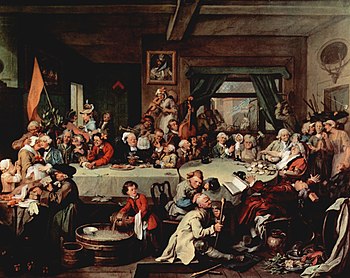
Rich vocabulary of creative moments share the basic assumption that innovation is a "single thing...a single moment". But he advocates that innovation is a network. Innovation is simply looking at a problem differently and coming up with something new. "The spaces that lead to innovative thinking look like this..." Hogarth's painting "Humours of an Election," what Johnson calls "The Liquid Network".

Johnson recalls research conducted by Kevin Dunbar, using "the Big Brother approach," recording conversations of ideas, trying to find that "Eureka" moment. What he found was that breakthroughs happened at the conference table when researchers discussed progress & problems, bouncing ideas off of each other.
Steven Johnson determined that "important ideas have long incubation period," what he calls "The Slow Hunch." He uses the example of Charles Darwin, who, from analysis of his copious notes, had the full theory of evolution months and months before his self-described epiphany, but who was unable to think it out fully.
Johnson concludes that creating ideas requires time to think, as well as the opportunity to share the hunches or ideas. The idea of connect ideas rather than protecting ideas with intellectual property restrictions - the power of open innovation. He ends with this thought: "Chance favors the connected mind."
I see that Johnson's ideas about, um, ideas, justifies the changes librarians have been making within their libraries and with their job descriptions. By opening the library to small groups, by encouraging the application of group projects, by providing the mild stimulants delivered in coffee and tea, we are providing the environments necessary to connect ideas. But we are not merely conference rooms - the "liquid" in our networks is not the coffee, but rather the knowledge and information provided via books, articles, databases, reference works, manuscripts, music, images, maps, as well as locally-generated resources like posters and presentations from students and faculty. We could further enhance this connectedness by making our resources more accessible, find-able, manipulate-able, and useful to our members.
Shared patterns of innovation, even within biological systems.
Rich vocabulary of creative moments share the basic assumption that innovation is a "single thing...a single moment". But he advocates that innovation is a network. Innovation is simply looking at a problem differently and coming up with something new. "The spaces that lead to innovative thinking look like this..." Hogarth's painting "Humours of an Election," what Johnson calls "The Liquid Network".
Johnson recalls research conducted by Kevin Dunbar, using "the Big Brother approach," recording conversations of ideas, trying to find that "Eureka" moment. What he found was that breakthroughs happened at the conference table when researchers discussed progress & problems, bouncing ideas off of each other.
Steven Johnson determined that "important ideas have long incubation period," what he calls "The Slow Hunch." He uses the example of Charles Darwin, who, from analysis of his copious notes, had the full theory of evolution months and months before his self-described epiphany, but who was unable to think it out fully.
Johnson concludes that creating ideas requires time to think, as well as the opportunity to share the hunches or ideas. The idea of connect ideas rather than protecting ideas with intellectual property restrictions - the power of open innovation. He ends with this thought: "Chance favors the connected mind."
I see that Johnson's ideas about, um, ideas, justifies the changes librarians have been making within their libraries and with their job descriptions. By opening the library to small groups, by encouraging the application of group projects, by providing the mild stimulants delivered in coffee and tea, we are providing the environments necessary to connect ideas. But we are not merely conference rooms - the "liquid" in our networks is not the coffee, but rather the knowledge and information provided via books, articles, databases, reference works, manuscripts, music, images, maps, as well as locally-generated resources like posters and presentations from students and faculty. We could further enhance this connectedness by making our resources more accessible, find-able, manipulate-able, and useful to our members.
Tuesday, December 4, 2012
Frequency of Letters
From Stephen's Lighthouse - a Zipf distribution of letters used.
Friday Fun: Frequency of Letters:
Frequency of Letter Use
http://ilovecharts.tumblr.com/post/35567084750/frequency-of-letter-use-via-kurt-white

Stephen
Friday Fun: Frequency of Letters:
Frequency of Letter Use
http://ilovecharts.tumblr.com/post/35567084750/frequency-of-letter-use-via-kurt-white
Stephen
Monday, December 3, 2012
Perusing interesting ideas on a Sunday Morning
I've developed a new routine these last few weeks of watching TEDTalks on my TV (the convergence of TV & Internet in action) and reading miscellaneous blog entries on Sunday mornings while my better half is enjoying riding his motorcycle on the nearly empty streets. Of course, my dog would rather I be taking him to the park, but his fun will come later. This is my time to think and learn. And here is what I've discovered this week:
If we want to help people, Shut Up and Listen! Ernesto Sirrolli discusses the seemingly obvious lesson learned from decades of failed Western-based aid projects in African nations. For instance, after attempting to teach some villagers how to raise Italian tomatoes in a rich valley, all the fruits of their labor were lost to the migrating hippos. Sirrolli sums up why the villagers did not tell him about the hippos - because he didn't ask.
Sirrolli takes this lesson learned and applies it to his own NGO of nurturing entrepreneurship in developing countries. His method is to approach a potential client with no problems to address and no solutions in mind, but rather to listen to what the client wants to accomplish and what solutions he or she has in mind. While addressed to those in NGOs, this lesson should (and sometimes is) applied to librarianship. Consider collection development. Rather than prescribing the kinds of materials for a particular subject or collection, we should be listening or paying attention to what our readers (faculty and students) use and need. They may not know the specific items, but they know they what they want to accomplish. What we can provide is the knowledge of publishing and literature, as well as storage and retrieval, that enables the selection of and access to the most useful materials that will enable them be successful.
From The Scholarly Kitchen, I've read an essay that advocates relying too extensively on "metrics" or even "altmetrics" to measure the quality of scholarly communication. His alternatives to metrics, or "alt2metrics," addresses the problem that our current quantitative metrics (e.g. impact factor, Eigenfactor, etc.) are dismissed by the very sources of scholarly communications - the academic researchers: "More often than not, academics and researchers are dismissive of metrics, as they’ve seen how, once you poke at them, they end up being relatively blunt measures with little nuance or depth." The author, Kent Anderson, then describes what he believes are the factors that the researchers pay attention to when evaluating research, namely:
If we want to help people, Shut Up and Listen! Ernesto Sirrolli discusses the seemingly obvious lesson learned from decades of failed Western-based aid projects in African nations. For instance, after attempting to teach some villagers how to raise Italian tomatoes in a rich valley, all the fruits of their labor were lost to the migrating hippos. Sirrolli sums up why the villagers did not tell him about the hippos - because he didn't ask.
Sirrolli takes this lesson learned and applies it to his own NGO of nurturing entrepreneurship in developing countries. His method is to approach a potential client with no problems to address and no solutions in mind, but rather to listen to what the client wants to accomplish and what solutions he or she has in mind. While addressed to those in NGOs, this lesson should (and sometimes is) applied to librarianship. Consider collection development. Rather than prescribing the kinds of materials for a particular subject or collection, we should be listening or paying attention to what our readers (faculty and students) use and need. They may not know the specific items, but they know they what they want to accomplish. What we can provide is the knowledge of publishing and literature, as well as storage and retrieval, that enables the selection of and access to the most useful materials that will enable them be successful.
From The Scholarly Kitchen, I've read an essay that advocates relying too extensively on "metrics" or even "altmetrics" to measure the quality of scholarly communication. His alternatives to metrics, or "alt2metrics," addresses the problem that our current quantitative metrics (e.g. impact factor, Eigenfactor, etc.) are dismissed by the very sources of scholarly communications - the academic researchers: "More often than not, academics and researchers are dismissive of metrics, as they’ve seen how, once you poke at them, they end up being relatively blunt measures with little nuance or depth." The author, Kent Anderson, then describes what he believes are the factors that the researchers pay attention to when evaluating research, namely:
- Brand (of journal)
- Authorship (within the journal)
- Results
- Sponsorship
My thought, however, is that these are exactly the kinds of "signals" that the metrics are trying to quantify. Impact factors are closely associated with brand of journal, as well as sponsorship, while h-index and the citation networks measure author productivity and impact, as well as networking. Kent is advocating that we (those interested in measuring the quality of science) not ignore the "primary, original signals of value" that "scientists rely on every day to guide them and their searches for information." This does make sense, but I'm beginning to believe that the Uncertainty Principle applies to many, many more things than physics. I'm sure I'm not the only one who's come to this conclusion...
Wednesday, November 21, 2012
Library Stacks - The love-hate relationship we have
"Library stacks" - this phrase, or more simply, "the stacks", is intimately tied with libraries and librarianship, particularly academic libraries. I grew up in my mother's elementary school library, and spent many hours at the local public library. My military service included a stint as base librarian and my first post-service civilian job was at a small public library. However, I had always references (and had heard referenced) the particular furniture that holds up the books as "shelves" or "shelving". I did not encounter the word "stacks" until I started library school (my undergraduate education was mostly independent of any one institution). I recall entering the Texas Woman's University library looking for a particular journal article and told to "look in the stacks". Not being particularly dense, I realized "stacks" = "shelves". I was thrilled to start using my first professional lexicon as an embryonic librarian: "stacks". It sounded both ancient and mystical, so much more magical than the mundane, "shelves". I have shelves in my home - only the library has "stacks".
"Stacks" is often associated with the academic experience, at least of the more studious, er, well, students. In an episode of the "Bob Newhart Show", as Emily is struggling to finish her master's in education, she rushes out when she learns that she has a "stacks pass" for that evening. To "go into the stacks" intimates an image of entering a labyrinth of narrow aisles and wondrous treasures. Scholars in the Stacks is a tribute to the Widener Library at Harvard, with short eulogies by humanities scholars describing their experiences navigating these labyrinths.
The the word is most deeply embedded in our sense of librarianship. Being a prototypical librarian, I did a quick search of LISTA, limiting my results to trade publications and magazine articles in order to get a sense of the phrase in the professional culture. Several article titles jumped out at me, confirming my suspicion of just how deep the term is to us: "A walk in the stacks", "Behind the book stacks: tales of a new librarian", "Caught between the stacks and a hard place: Dealing with librarian stereotypes", and "Lost in the Stacks". Thus, it is no surprise when I searched for "library stacks blog" in Google and found a wealth of cultural expression: Closed Stacks, From the Stacks, An Anthropologist in the Stacks, and several "In the Stacks" blogs from academic libraries. It was also no surprise to find a wealth of books on librarianship referencing this word, including In the Stacks by Michael Cart, Sacred Stacks by Nancy K. Maxwell, Straight from the Stacks by Laura T. Kane, and of course, Vandals in the stacks? : a response to Nicholson Baker's assault on libraries by Richard J. Cox. Using the Google Ngram Viewer, I got this graph of lexical usage of the phrase, "library stacks":
This corresponds to the WorldCat search, limited to books, where the earliest entries found were in the late nineteenth century. "In the stacks" appears to be of much later origins, with both WorldCat and Google Ngram showing the earliest references in librarianship to be around the 1920s.
Barbara responds with a question of her own, which she answers:
So, it is clear to me that librarians have a love-hate relationship with "the stacks" that will likely not cease even if (when?) the last set of shelves are removed (see Kane's latest book, Working in the virtual stacks : the new library & information science).
"Stacks" is often associated with the academic experience, at least of the more studious, er, well, students. In an episode of the "Bob Newhart Show", as Emily is struggling to finish her master's in education, she rushes out when she learns that she has a "stacks pass" for that evening. To "go into the stacks" intimates an image of entering a labyrinth of narrow aisles and wondrous treasures. Scholars in the Stacks is a tribute to the Widener Library at Harvard, with short eulogies by humanities scholars describing their experiences navigating these labyrinths.
The the word is most deeply embedded in our sense of librarianship. Being a prototypical librarian, I did a quick search of LISTA, limiting my results to trade publications and magazine articles in order to get a sense of the phrase in the professional culture. Several article titles jumped out at me, confirming my suspicion of just how deep the term is to us: "A walk in the stacks", "Behind the book stacks: tales of a new librarian", "Caught between the stacks and a hard place: Dealing with librarian stereotypes", and "Lost in the Stacks". Thus, it is no surprise when I searched for "library stacks blog" in Google and found a wealth of cultural expression: Closed Stacks, From the Stacks, An Anthropologist in the Stacks, and several "In the Stacks" blogs from academic libraries. It was also no surprise to find a wealth of books on librarianship referencing this word, including In the Stacks by Michael Cart, Sacred Stacks by Nancy K. Maxwell, Straight from the Stacks by Laura T. Kane, and of course, Vandals in the stacks? : a response to Nicholson Baker's assault on libraries by Richard J. Cox. Using the Google Ngram Viewer, I got this graph of lexical usage of the phrase, "library stacks":
 |
| Ngram of "library stacks" |
Now, all of my thoughts about this phrase did not, of course, come out of the blue. You are probably already aware of Barbara Fister's recent post to her blog, Library Babel Fish, Stacks and Awe, in which she, herself, references yet another blogger's post regarding "the stacks" by Bohyun Kim. Kim questions the romantic association of scholarly research with solitude and serendipitous discovery of the stacks. Indeed, she poses a very intriguing question (emphasis on the question added):
The fast and convenient e-resources in library websites and the digital library collections seem to deprive us of something significant and important, that is, the secluded and sacred space for thought and contemplation and the experience of serendipitous discovery from browsing physical library collections. However, how much of this is our romantic illusion and how much of it is it a real fact?Kim then references qualitative research by Bess Sadler presented at the 2012 ACCESS Conference that shows the association of emotional terms to the physical stacks ("joyous", "immersive" and "beautiful"), and more concrete terms to digital collections (e.g. "efficient" and "fast"). Sadler commented how the online research environment had not yet captured the same allure and emotional experience of simply "browsing the shelves". In her blog post, Kim pointed out the obstacles to "flow" that the physical stacks and the online research tools each presented. When needing "rare scholarly books", she described her frustration at the sheer distances she had to navigate, both between libraries and within, especially when the books were not where they should have been. Conversely, she describes the annoyances of pop-up reminders and the multiple layers of authentication that can disrupt "being in the zone" of online research.
Barbara responds with a question of her own, which she answers:
Why is abundance so exhausting when it’s on the screen, so inspiring when it’s on the shelves? There’s a sense of patience in the stacks, an impression that time slows down. With your call number in hand (or sent as a text message to your phone), it’s tempting to check out what else is there.The Web, being what it is, enables quick dissemination of these expositions and inevitable responses, including from the Library Loon. In On Hating the Stacks, the Library Loon "confesses" that she "hates academic-library stacks". Indeed, there is much of the stacks to disdain - dark, "yawing caverns", dust that can tear up the eyes making reading nearly impossible, stairs and steps (I, too, wonder how our members in wheelchairs would navigate these aisles barely wide enough for a super-model to walk down), and of course, incredibly long call numbers.
So, it is clear to me that librarians have a love-hate relationship with "the stacks" that will likely not cease even if (when?) the last set of shelves are removed (see Kane's latest book, Working in the virtual stacks : the new library & information science).
Tuesday, October 30, 2012
Libraries by collection size, things you didn't learn in library school, and more...
I've been collecting a few items from my regular blog-reading about which I wanted to comment, but for which I hadn't found the time. So rather than write a posting for each, I'll lump them together.
First, there is the Top 100 Libraries by Collection Size that was recently put out by ALA. My very first thought was, really? Collection size? I thought this was a metric that was on its way out, but apparently it has more staying power than I had realized. My next thought was, wow, Dallas Public Library (41) beats Houston P.L. (100) - woo hoo! A third thought - drats, University of North Texas wouldn't have made the cut even if they included those academic libraries not in ARL.
Now that you should have recognized my own ambivalence to towards this stat, perhaps we should consider why this is. Of course, it's a (relatively) easy thing to measure - how many books (although the lengthy caveat at the should give a hint to how complicated it is to measure number of books - by volumes? titles? items? etc.). ...
In the blog, Letters to a Young Librarian, Jessica Olin listed the 10 Things I Didn't Learn in Library School, including:
First, there is the Top 100 Libraries by Collection Size that was recently put out by ALA. My very first thought was, really? Collection size? I thought this was a metric that was on its way out, but apparently it has more staying power than I had realized. My next thought was, wow, Dallas Public Library (41) beats Houston P.L. (100) - woo hoo! A third thought - drats, University of North Texas wouldn't have made the cut even if they included those academic libraries not in ARL.
Now that you should have recognized my own ambivalence to towards this stat, perhaps we should consider why this is. Of course, it's a (relatively) easy thing to measure - how many books (although the lengthy caveat at the should give a hint to how complicated it is to measure number of books - by volumes? titles? items? etc.). ...
In the blog, Letters to a Young Librarian, Jessica Olin listed the 10 Things I Didn't Learn in Library School, including:
- For most students, asking librarian for help is a last resort.
- Students don't know how to find a book in the stacks.
- The library (the department) is not always in charge of how the library (the space) is used.
- Collection development is done differently in every library.
This last struck me as rather obvious - after all, nothing is ever done the same way in every place (office, library, even military base). After all, simply following Ranganathan's 5 Laws, it would be apparent that different libraries have different readers needing different works.
Finally, there was this review of the soon-to-be released special issue of Against the Grain that focuses on usage data. Unfortunately, I just now sent in my check to subscribe to this trade journal, so I won't have access to the articles for a while (why can't we submit payment online!?!). The reviewer, Scott McLemee, is an essayist with a background in the humanities, but he is not a librarian; this is both good and not-so-good for the same reason: outside perspective. The emphasis of his blog posting is on the journal metrics, including impact factor, immediacy impact and h-index. While initially developed for use in the scientific journals, these metrics have been gradually included in reviews of journals, articles and authors in the social sciences and humanities. So it's not surprise that Scott raises concerns; what does surprise me is a humanities writer who does not express utter disdain for these measures. True, there are issues with them, but there are also innumerable issues with the subjective measures of opinion (whether evaluating a journal for submitting an article or adding to a collection, or evaluating the work of a researcher for tenure). I do look forward to getting access soon to ATG.
Finally, there was this review of the soon-to-be released special issue of Against the Grain that focuses on usage data. Unfortunately, I just now sent in my check to subscribe to this trade journal, so I won't have access to the articles for a while (why can't we submit payment online!?!). The reviewer, Scott McLemee, is an essayist with a background in the humanities, but he is not a librarian; this is both good and not-so-good for the same reason: outside perspective. The emphasis of his blog posting is on the journal metrics, including impact factor, immediacy impact and h-index. While initially developed for use in the scientific journals, these metrics have been gradually included in reviews of journals, articles and authors in the social sciences and humanities. So it's not surprise that Scott raises concerns; what does surprise me is a humanities writer who does not express utter disdain for these measures. True, there are issues with them, but there are also innumerable issues with the subjective measures of opinion (whether evaluating a journal for submitting an article or adding to a collection, or evaluating the work of a researcher for tenure). I do look forward to getting access soon to ATG.
Monday, October 29, 2012
ARL's Webinar on the HathiTrust decision
ARL sponsored this Webinar that featured knowledgeable persons giving their understandings of the background and impact of this landmark decision. Here are several points and quotes that caught my attention:
- Daniel F. Goldstein, on the accessibility argument of the case:
- "Finally, there's a lever here for you in dealing with vendors who sell you digital content, because of the strong statements about the need for equal access and the statements about fair use, you can tell Elsevier, they either need to start making those online journals in an ePub3 format that's accessible, or that if they don't, you as a library are entitled to do so as fair use, to create the accessible copies as fair use."
- "...it [the decision] blessed making a digital copy as a fair use if the purpose is for access to persons with print disabilities."
- Libraries no longer have to wait for a request from a print-disabled student to digitize texts for that purpose. In addition, libraries can retain the digitized copy even after the student has completed the course or left the university, rather than having to re-create the digitized copy from each student's own copy of the texts.
- Peter Jaszi, also on accessibility:
- "...the more a library does to create a systematic and well-thought out program to serve the needs of the print-disabled, the closer it works with the disability services office on campus to those ends, the stronger the position it will be in to assert that it is an authorized entity under section 121." (emphasis original)
- Jason M. Schultz, on preservation
- "purpose matters" "libraries...preserve for another purpose, to make sure we have this cultural heritage, to make sure there are resources for scholars, to make sure we can have access to literature in as many different forms as possible for many different populations..."
- Essentially, a "dark archive" of items digitized for "preservation" only (without the extended purpose of, say, for future scholarly research) may not be permissible, but that this is not usually the case. Preservation is almost always for another purpose beyond itself.
- Future of this decision? Will it be appealed? Should libraries take action?
- Jonathon Band - the Author's Guild will seek a settlement to drop any appeals in exchange for not paying HathiTrusts' legal fees (a likely outcome of this decision).
Subscribe to:
Posts (Atom)