Saturday, July 20, 2013

Time for a little dissent

A series of blog postings on blogging in librarianship have rattled the library blog-world.  Andy Woodworth started it with his rant (used with the best of intentions) on his own blog, Agnostic Maybe.  In Waiting for Batgirl (am I the only one who saw the reference to Waiting for Guffman?), Andy skewers library blog writers, and even librarianship as a whole profession, as "mostly been either puppies-and-rainbows positive or uncontroversial benign kinds of things."  When referring to the difficulty in expressing discontent, he writes:
Public dissent is considered gauche in a profession that proudly supports the societal provocateurs, miscreants, and iconoclasts but wants to keep discontent in-house. I could easily write a thousand entries about helping people on a daily basis, but the whole library façade will collapse and burn if I was write about my frustrations regarding a policy, decision, or the work environment.
I must admit that I was a bit bewildered at Andy's own bewilderment - at the predominance of "banal" topics that top the library blog-charts, at the "energy" spent pointlessly rebutting that which "people stroke themselves into a self-righteous lather over," and the hypocrisy of the ALA hailing Edward Snowden as a "whistleblower" (the analogy provided in the comments by Shalom is spot-on).  Why is this such breaking news? Are there other professions that are notably better? Isn't this just being human?
OK, I did relate to his comments about waiting - for the right time, the right place, the right people - to tackle problems that stir the passion in me.  Is this just being pragmatic?  Or is that a cop-out?
All of the comments to his post were supportive - interestingly, nobody reproached him, nor provided any rebuttal to his ravings made with very colorful language.  Indeed, it seems almost hypocritical not to be expecting any negative or at least critical (in the highest sense) response.
In this vein, Chris Bourg posed the question, Does the Library World Squash Dissent? on the Taiga Forum.  He genuinely asks (not rhetorically, he stresses) -
(H)ow can we as leaders encourage healthy, honest, public conversations about our profession — the good, the bad, and the ugly? And where exactly is the line between unprofessional trash-talking and healthy, thoughtful critical dissent? Those of you who are afraid to speak out, what would have to change for you to feel safe making your thoughts known? And how do issues of race, class, gender, sexuality and other dimensions of difference and power play into this?
Regarding the idea that librarianship may not be different from other professions, Chris retorts that "librarians SHOULD be different. We have stated values of Diversity, Democracy, and Intellectual Freedom — we ought to be a radically open profession. One that celebrates dissent, and that recognizes that there is tremendous power in disagreements."
Not surprisingly, the Library Loon offered her own answers to Chris' questions.  In Silencing, Librarianship & Gender: A Preface, the Loon delivers her answer in her characteristic third-person, confirming the charges Andy made regarding reprisals and recriminations for speaking out.  When asked how to encourage "healthy, honest, public conversations about our profession", the Loon commands to "not discourage or punish the open expression of anger or frustration, especially while it is still small and remediable. "
The Library Loon then refers to her own numerous writings on silencing dissent, which makes me wonder if the situation is like the weather - everybody complains, but nobody is doing anything about it.  I, like you, had followed the travails of Jenica Rogers' open rejection of ACS and the ensuing discussion that devolved into name-calling and not-so-vailed sexism.  True, the focus was deflected (and rather effectively, I might add) from the issue at hand - notably extraordinary price increases for resources "required" for accreditation by the same body that publishes them (note eyebrow raised) -- to "professional behavior" (how many envisioned the ACS spokesperson as a caricature of a 1930's Lionel Barrymore sniffing at Audrey Hepburn?).
So, after all have added their comments (and Tweets) to all of the blog postings that Andy's post has spawned (including this one), will we be better off?  Or will this be another rant in the wind?

The Performance-based Funding Model: Creating New Research Databases in Sweden and Norway

This article made me wonder about our own institution's impact on research, and notably, how the library could help its members increase their impact.  One of my original 5-year goals was to establish a "Research Impact Measures Service" - a la University of New South Wales in Australia.  This service would not only assist the researchers in their own performances, but also for departments and even university-wide.  I still keep this idea in the back of my mind...and it comes forward when reading articles such as this.
This article refers to national efforts to develop quantitative measures of impact as one (sometimes the primary) decision factor in disseminating funding.  There are, of course, many opinions on the validity and value of such methods.  It does tend to reward success, but, like pure capitalism, this can lead to greater differences between the "haves" and the "have-nots".  It can also stifle innovation by essentially betting on sure things. Many breakthroughs start with research that has high risks of failure.
But it did get me thinking about comparing my university's output with others.  A cursory look at data from Web of Knowledge (a resource with documented limitations) demonstrates that the university's impact has been limited.
2000-Current# ArticlesArticles Ratio# CitationsCitations Ratio# Citing ArticlesCiting Articles RatioAvg CitesAvg Cites Ratioh-indexh-Index Ratio
UNT86291.00642731.00483731.008.281.00861.00
UT Dallas83670.971068731.66786441.6313.91.681121.30
UT Arlington99721.16925871.44684231.4110.521.27971.13
UT San Antonio56640.66365930.57312000.647.30.88660.77
           
2008-2012# ArticlesArticles Ratio# CitationsCitations Ratio# Citing ArticlesCiting Articles RatioAvg CitesAvg Cites Ratioh-indexh-Index Ratio
UNT39921.00158981.00124481.004.451.00421.00
UTD41571.04278981.75212281.717.271.63601.43
UTA51371.29296371.86217181.746.61.48571.36
UTSA41371.04235051.48190701.536.511.46561.33
Rice81432.04878315.52592124.7612.282.761032.45
Texas Tech87612.19385172.42293872.365.471.23631.50
This is a puzzle -- UT Dallas published as many articles as UNT, but had over 50% more citations.  I would like to investigate this further - is it due to differences in subject coverage?  UT-Dallas was initially started as a upper-level and graduate school focusing on technology.  UNT was originally a teacher's college - research has been a relatively recent focus.  Could the association with the UT System be a factor?  This could also help explain the how UT-Arlington, which similarly started as a teacher's college, has 40% more citations and a higher h-index than UNT.  This explanation fails, though, in the comparison with UT San Antonio.
This brief inquiry has only raised more questions.  I would like to delve into the details more thoroughly, controlling for number of faculty, subject coverage, longitudinal trends, graduate degrees awarded - what else?  I'd really like to know how my institution could get more respect.

Sunday, July 14, 2013

The end of the beginning...

Reminder: This blog is being superseded by Libraries Are For Use.  Please update your feeds.
I've been doing some serious reconsideration about my blog -- are my words being read? (well, a little)  Do I have regular readers? (well, a few)  Am I satisfied with my work? (well, the writing is OK, but the response has been disappointing)  What can I do differently?

For one thing, I've never been satisfied with the name.  I had never read the work on which the name of this blog was based (Being and Nothingness), nor had I explored Sartre's philosophy in any depth...I had just considered the idea of considering librarianship from an existential perspective (what little I know about existentialism). I was particularly interested in bringing together the theoretical or philosophical ideas of, with the practice of librarianship. But the name struck me (even then) as being a little too obscure and, well, pretentious.

Then there is the platform...I chose Blogger because that is what I had used years ago.  I already had my profile set up, I was familiar with the features, and it was easily tied in with my Google account.  However, it is, in my opinion, a little on the old-fashioned side, well, in Web terms.  It just seems so '90's.  When the NTLA blog was set up on WordPress, I liked that platform and decided it was time for a change.

After several weeks of transferring postings, and finally deciding on a template, I think the site is ready for a sneak preview.  I wanted a name the better reflects my own philosophy of my chosen profession, so I harkened back to my early postings about S.R. Ranganathan's Five Laws of Library Science.

Libraries are for Use is my new platform, my new soapbox, which I hope will generate a little more interest. I know, I know...changing blog names is like the character on Parks & Recreation changing his band names.  I could loose what few readers I have - would you leave?  I also know that content is more important than the name or platform.  If I want more readers, I need to write what readers want to read.  I'm working on that, too.  I'll be learning how to make infographics and writing more on more intriguing ideas.  I hope this change gives me some stimulation.

I will keep both blogs going for about a month.  In the meantime, please visit there and subscribe, Like, etc.  I've also got a PollDaddy poll asking for your input.

And thanks for listening.

Sunday, July 7, 2013

Seeking new answers...

Now that I'm nearing completion of the shortest statistics course ever (4 sessions over 10 weeks), I've started looking around for new questions to answer.  Luckily, I have a number of librarians and students who are also interested and desire the research experience.  Here's my new research agenda:
  • Gifts: since I'm tangently responsible for selection of gifts (the library student worker who evaluates and selects items from donations), I wanted to address this function.
    • Do our gift monographs "fill the holes" in our collections?  Do they cover areas that we desire to collect but otherwise don't?  This is actually a paradoxical question, because if we believe a particular subject is relevant to our users, then we should be purchasing resources; conversely, if we think a subject is not relevant, then should we even be adding gifts?  After all, even gifts cost the library resources for processing and storing.
    • Are gift monographs used as frequently as purchased monographs (adjusting for subject, age of book, time in collection, and accessibility)?  I have only found a couple of studies that looked at circulation, but I found the methodologies to be weak.  I hope to build in a little more rigor, while also still providing an opportunity for one of the library students to present and publish.
  • Demand-Driven Acquisitions (DDA): I'm deeply involved in our DDA program at UNT Libraries, which I believe has been fairly successful.  But there are some nagging questions:
    • Has demand-driven acquisitions (DDA) resulted in relatively fewer university press titles being purchased by UNT Libraries?
    • Is overall usage (circulation of print combined with ebook usage) of university press titles decreasing?
  • Remote storage: We are in the process of moving a large number of print books to our new warehouse facility for remote storage.  This isn't as remote as many academic libraries - just about a mile away from the main library, and users can request and receive any item within a working day.  But it does raise some interesting questions, including:
    • Will the removal of our print books to remote storage will have an impact on overall book circulation.  Technically there should not be a big impact, because the titles moved had not been used in what, 10 years?  But I think that the removal itself could increase the decline of circulation of print titles.
  • Googling vs. traditional research:  This is actually a question that a peer of mine has, and I volunteered to help out with methodology & analysis.  
    • "Has the quality of theses/dissertation references declined with the advent of Google and institutional repositories?"  There is plenty of evidence that Google is often the resource of first resort for nearly everybody, but is it leading doctoral students (and their faculty mentors) to accept lower quality resources?  Of course, the hard part will be objectively measuring quality of references, but this should only add to the challenge.
Other irons that are still in the fire include:
  • What are the effects of our Discovery system (Summon) on vendor-supplied usage stats?  Changes in the ProQuest platform have affected their usage stats, so I've been a little stymied in this quest.
  • Do bibliographic enhancements to catalog records (like tables of contents & additional keywords) increase the chances of an ebook being used?  This information could be used to support our purchase of enhanced MARC records.
This is a rather ambitious agenda, which can only be made possible by the collaboration with others.  Is there anybody who would like to join in?  I see presentations and publications from all of these, and collaboration with other librarians in other libraries, regions or specialties will only add to the universality of the results.

Saturday, June 29, 2013

Virtual browsing of remote storage

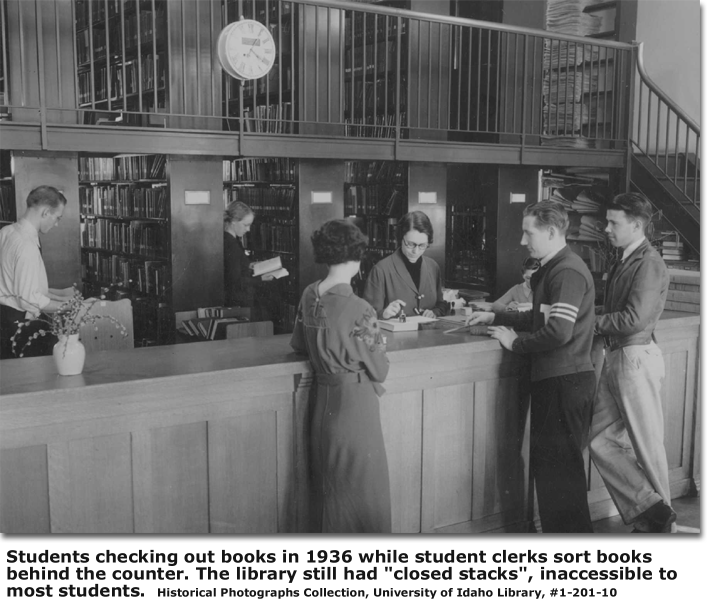
Between 50 & 100 years ago, there was a different kind of Open Access movement in libraries...this one more of the physical kind.  I'm referring, of course, to the opening of the stacks.  In a quick search Library Literature Retrospective (1905-1983), there were articles about opening the stacks as late as 1982.  Here's an article from CR&L, 1954: Open or Closed Stacks?  Even when open, the access to the stacks was often highly regulated.  I recall an episode of The Bob Newhart Show (circa 1974) when Emily, in her pursuit of a master's degree, is excited to learn that she and her study partner have a "stacks pass".  The biggest concerns of librarians and administrators were, of course, the security of the collection.  Losses due to theft, as well as misshelving, were the most common concerns.  But, as the article linked above indicates, most libraries had minimal losses (<2%), and increased circulation (upwards of 50-100% or more).

But as the relative funding of libraries shrinks to below 2% of universities' budgets and service priorities shift away from physical books, many academic libraries are moving their books into remote storage, effectively closing the stacks once again.  Access is limited to effectively a paging service for known items.  Because of the loss of serendipity from browsing the shelves, this increases the importance of the metadata for searching, finding, and identifying the right books.  The primary source of metadata, of course, is the catalog, particularly for the kind of books that are being relocated.  Even when incorporated into discovery systems, the primary source is the bibliographic record.

But, as we all know, library catalogs leave a lot to be desired...OK, they suck (see here, here, and here).  They have evolved very little from their beginnings of lists of titles on pages (literal pages and metaphorical pages).

The addition of enhanced content of bibliographic records helps in the selection process.  But against the old adage, we judge much about a book from its cover.  That is why Aaron Tay's look at "virtual shelves" was intriguing to me.  At a time when our library is moving a big chunk of its collection to a remote (albeit local) storage, I've been wondering how we were going to replicate the experience of serendipity.  Interestingly, most of the eight virtual shelves he reviews show covers from the front, even though physical books are shelved showing the spines.  This is because that is what is available - small images of book covers.  Also, most show the books using a horizontal scroll.  Harvard's StackLife shows "spines" of results in a vertical stack, with width and length based on the physical size of the book.  One additional feature is to visually represent popularity of a title by the darkness of the color, based on total circulation.

One problem with all of the systems that use book jacket images is that, for many of the titles being moved into remote storage, there are no covers available.  These are often older, less popular titles - that's why they are being moved.  So the results use a "faux" cover, with the title layered on top. This defeats the purpose of "virtual shelves". It is no better than a list of titles.

I just don't think our catalog systems have the capability to effectively replace the efficiency of locating a section of the shelves and browsing.  Perhaps with some combination of Amazon's LookInside, Harvard's StackLife, and the library's rich metadata, we can get a little closer.

Sunday, June 16, 2013

Boy! That air feels good!

Given that today is Father's Day, I would like to plug my father's newest book (OK, it's his first, but what a first!).  Boy! That Air Feels Good: The Untold Story of Car Air details how it was entrepreneurs, mostly in the Dallas-Fort Worth area, and not the big guys in Detroit, who got us air conditioning in cars.

I am very proud of my father for seeking out and interviewing the original developers and makers, searching archives at the Dallas Public and UT Arlington libraries, seeking and obtaining permissions for use of photos and diagrams, and, of course, writing a narrative that is interesting and takes you back to that time period.  I love his vivid description of a young auto mechanic in the early days of car AC, with business booming and enough work to get him through the summer.  Actually, except for the pack of cigarettes in the rolled-up sleeve, the image in my head as I read it was of my Dad, working in his white cotton t-shirt, before he grew his beard.


This book describes the various renditions of auto ACs, including those that took practically the entire truck space and poured ice-cold air on to the rear seat passengers freezing their ears off.  There are schematics, diagrams, sketches, and photos.  There are stories of business intrigue and personal backgrounds of key players in the field.   Despite the forays into the technical nitty-gritty, I was able to understand how these things worked.


While I know this venue isn't exactly major media, I did want to pay tribute and show off the fruits of my father's labor.  And for his next work, he's wanting to finish a juvenile story about a Japanese boy who accidentally takes off in a balloon and lands in the American desert.  Actually, I was hoping he'd work again on his tale of a little car that is used in whisky runs during Prohibition, by guerilla fighters in Czechoslovakia, and so on through various other adventures.  Sort of like a mechanical version of War Horse.

Feel free to peruse the Amazon "Look Inside" and consider buying your own copy - or tell a friend.

Interesting stuff - for an Assessment-Nerd

I recently received the feed of latest articles from Evidence-based Library & Information Practice (EBLIP), which included conference papers from the 2010 Library Assessment conference, as well as a few original articles & research summaries. (Official Disclosure: I am a peer-reviewer for EBLIP.)  Here is the official scope statement:
EBLIP is a peer reviewed, open access journal published quarterly by the University of Alberta Learning Services, using the OJS Software. The purpose of the journal is to provide a forum for librarians and other information professionals to discover research that may contribute to decision making in professional practice. EBLIP publishes original research and commentary on the topic of evidence based library and information practice, as well as reviews of previously published research (evidence summaries) on a wide number of topics.
Of course, as a librarian with a background in research, I was drawn to this journal waaaaay back at my previous library.  Now I regularly read the articles, looking for gems and ideas for my own professional interests.  This issue, I was not disappointed.  From the 2010 Library Assessment conference, there is a heavy emphasis on ARL assessment products, including LibQUAL+® and its sister product, ClimateQUAL+®, but I was more interested in the articles on such topics as assessing special collections, faculty dissatisfaction with their libraries' journal collections, and linking outcomes with library resources and instruction.  While the conference papers are a bit old (OK, maybe not in "LIS time", but I'm still on "biomedical time"), I still found them quite useful. Here is my take on a few of the key articles, features and evidence summaries.

Still Bound for Disappointment? Another Look at Faculty and Library Journal Collections by Jennifer Rutner (Columbia University) and Jim Self (Univ. of Virginia)
Research Questions:  Are faculty at other ARL institutions all dissatisfied with their libraries' journals?  “Given the substantial investment in journals at ARL libraries, why are faculty at these institutions consistently dissatisfied with their library’s journal collections?”
What they did: Analyzed LibQUAL+ data from over 20 ARL libraries, and interviewed faculty at Columbia to find out more specifically why they are dissatisfied.
Take-home message: Faculty at many ARL libraries are not satisfied with their libraries journals, but not necessarily for the reasons you think.  Many of the issues brought up by Columbia faculty, at least, were technical in nature (e.g. poor "automated responses from library systems", poor search interfaces, etc.) and fall under the umbrella of User Experience.  C'mon, folks - let's get together on this.  We can make the user experience better if we just start working together.

Linking Information Seeking Patterns with Purpose, Use, Value, and Return On Investment of Academic Library Journals by Donald King & Carol Tenopir.
Research Questions: How are purposes of scholarly reading, information seeking behaviors, aspects of use, and positive outcomes or value all related?  How can we use this relationship to demonstrate our value (e.g. with an ROI)?
What they did: This is part of the IMLS-funded MAXDATA project, which included surveys of faculty at 5 universities using the "critical incident" method, asking respondents to think about the most recent information need when completing the survey.  Questions were asked about the purpose of their need, how the information was used, and the value they placed on that information.  Also asked was what the faculty would have done if that last article they used was not available - buy it? spend how much time looking for it?  Based on these responses & previous research, they calculated an ROI of the academic libraries.
Take-home message: Faculty read a lot of articles; they get most of their articles from library resources; the most recent articles are used the most and most articles from library resources are used electronically. Most of this information is not really new - King & Tenopir have been doing a lot of research on use & access.  A few interesting results: faculty spent more time reading articles from library resources than their own subscriptions (probably because more research articles were from the library), and faculty spent more time browsing than searching for each article.  Faculty would spend about 13 hours a year browsing, searching and obtaining articles if the library didn't provide them, which results in about $3500/faculty in cost savings provided by the library, or a 3.6:1 ROI.

Value of Libraries: Relationships Between Provision, Usage, and Research Outcomes by Michael Jubb, Ian Rowlands and David Nicholas out of England.
Research Question(s): Another attempt to derive a measure of value of libraries via the articles it provides.  This time, the link is more outcomes-based.  Specifically, what is the relationship of faculty's use of articles, institutional expenditures on journals, and faculty's research productivity?
What they did: They mined the Web logs of Science Direct and Oxford journals to get the information search & use behaviors.  Then they interviewed faculty and librarians at selected universities. This data was combined with previously-gathered COUNTER-usage data from a variety of British academic institutions.
Take-home message: Cost per download is going down as usage of ejournals increases. The size of the institution does not necessarily predict usage.  Expenditures on journals drives usage, but usage does NOT drive expenditures.  More interestingly, research success drives use.  They were unable, however, to find a factor that use drives - not even productivity.

There were several articles on the development and use of assessment systems and methods, including the University of Wollongong's "Library Cube", U Penn's MetriDoc, and ARL's Balanced Scorecard.

However, these are relatively older items (2010).  There were two articles of recent research that caught my eye - one was a citation analysis study for collection development, and the other was an attempt to provide a method of assessing special collections.

A Citation Analysis of the Classical Philology Literature: Implications for Collection Development by Gregory Crawford from Penn State.
Research Question(s): What are the citation patterns in the classical philology literature and how have these changed over time?
What they did: Examined each citation in every article in two specific years (1986 & 2006) of one journal prominent in the field, noting specifically age, format, language, length.  This was compared with study results from the 1950's.
Take-home message: Citation patterns have not changed a whole lot over the last 50 years.  Citations are about the same age (24-25 years), which is not too surprising given that the topics are 2500-3500 years old.    The distribution of citations by format haven't changed much either - 28-29%.  One interesting change has been an increase in the percentage of book citations (55% in 1956 to 68% in 2006).  This is due primarily to reductions in citations to Festschriften and dissertations.  There were more journal titles cited in 2006 than in 1986 - the author suggests that researchers were "casting a wider net".  This, however, does correspond with an increase in journal titles in all fields.  Eighteen journals made up the top 10 lists from all three years, with 4 titles in all 3 years, and 4 titles in two of the 3 years.  This suggests modest stability of literature.  This article will be of much interest when we look at our classical studies collection.

Data-Driven Decision Making: An Holistic Approach to Assessment in Special Collections Repositories by Melanie Griffin and Barbara Lewis of University of South Florida and Mark Greenberg, Western Washington University.
Research Question(s): How can all aspects of special collections be assessed to enable better decision-making?
What they did: Used Web site usage, patron surveys, usability studies, and Web analytics to answer a series of questions regarding staffing needs, staff-training needs, customer needs assessment and technical needs assessment.
Take-home message: It takes a village - of measures, at least -- to assess a library...of any kind.  While the title includes "holistic", I think it is more akin to triangulation or, essentially, comprehensive assessment.  However, this assessment was focused on the operations and marketing decisions.  It did not include any attempt to get at impact or outcomes of usage of their collections.  This would make it, indeed, holistic.

Finally, there were a number of evidence summaries - critical reviews of published literature.  Reviews that caught my attention were:

Well, reading all of these articles will fill my morning train commute next week.